

Structure protects what holds creative work together.
Thisness applies disciplined definition before direction begins to take form.
Creative work becomes unstable when foundation, expression, and execution collapse into one another.
Ideas move too quickly toward output. Direction forms before clarity has fully emerged. The result is often movement without alignment.
Thisness introduces structure before momentum overtakes definition.

Creative work operates across three connected layers.
Thisness
Defines the foundational principles the work remains aligned to over time.
Expression
Translates clarity into language, form, and direction.
Execution
Implements the work with craft and discipline.
These layers are connected, but distinct. When they become confused, projects drift. Expression begins reacting to momentum rather than principle. Execution accelerates before clarity stabilises. Thisness protects the defining foundation before expression takes shape.
The Thisness Method™
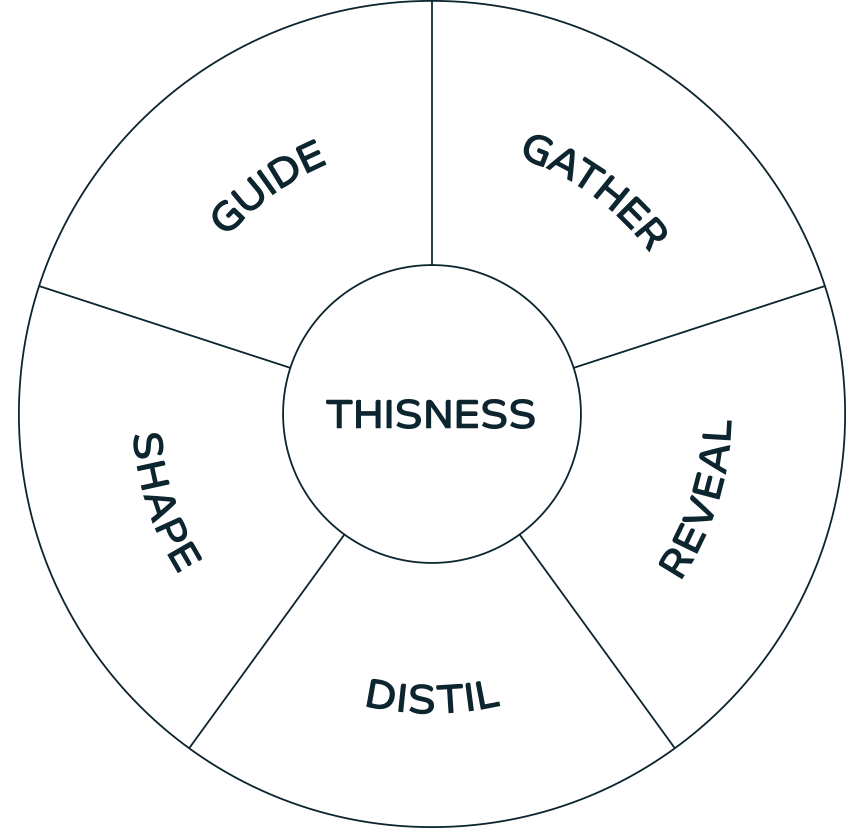
Clarity rarely appears fully formed. It emerges through structured attention.
Gather
Surface tensions, contradictions, and recurring signals.
Reveal
Notice what sits beneath the surface.
Distil
Reduce complexity until the defining centre becomes clear.
Shape
Translate clarity into narrative, language, and direction.
Guide
Protect coherence as the work evolves.
The method is not designed to manufacture meaning. It exists to recognise and articulate what is already there.
Structure protects coherence.
Creative tools accelerate execution. Thisness strengthens judgement.
When foundational clarity is established early, decisions become more intentional and expression gains stability.
Trade-offs become clearer.
Revisions reduce.
Direction holds.
This is not additional complexity. It is disciplined clarity.
Apply Thisness in practice.
The Toolkit provides the structure, language, and practical tools for applying Thisness consistently within creative work.
For practitioners seeking greater clarity, coherence, and authority behind the work they create.
Journal
The journal explores ideas around clarity, judgement and professional practice in creative work. Essays written to encourage deeper reflection on the work.
Contact
For enquiries relating to practitioner licensing, access or renewal, appropriate use of the discipline and educational or institutional enquiries –